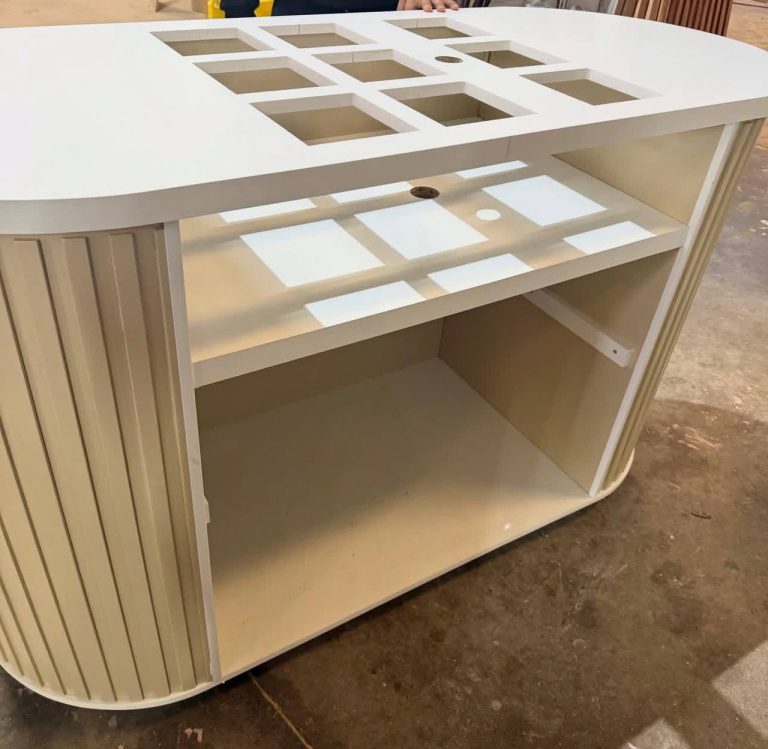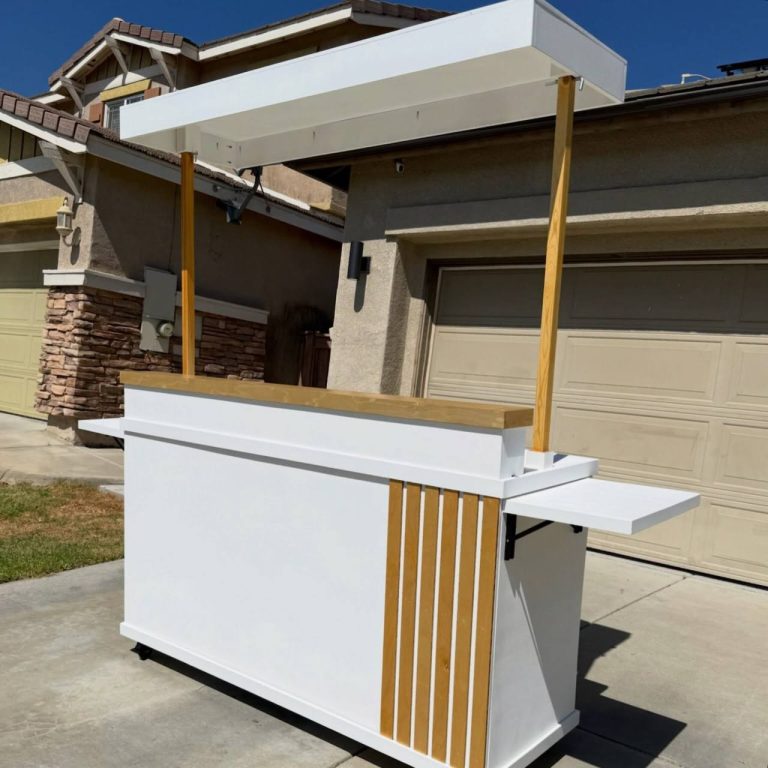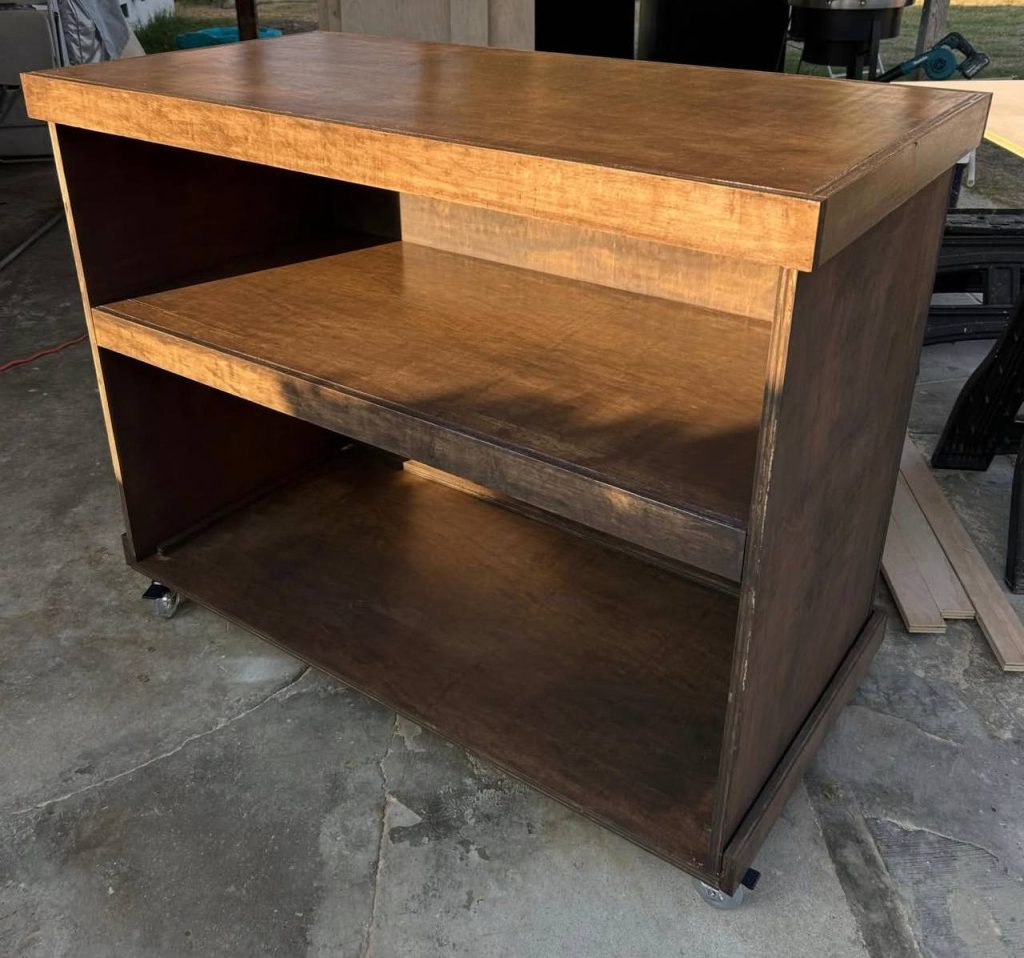
Every cart we build falls into one of three families: a fixed cart that is assembled and finished in the shop and arrives as one piece, a flat pack kit that ships as finished panels and goes together with a drill, or a collapsible cart that is designed to fold or break down after every event. People often ask which is best. The honest answer is that each one trades something away, and which trade you can live with depends on how you will use the cart and how it will travel.
Fixed carts: the strongest and the simplest to live with
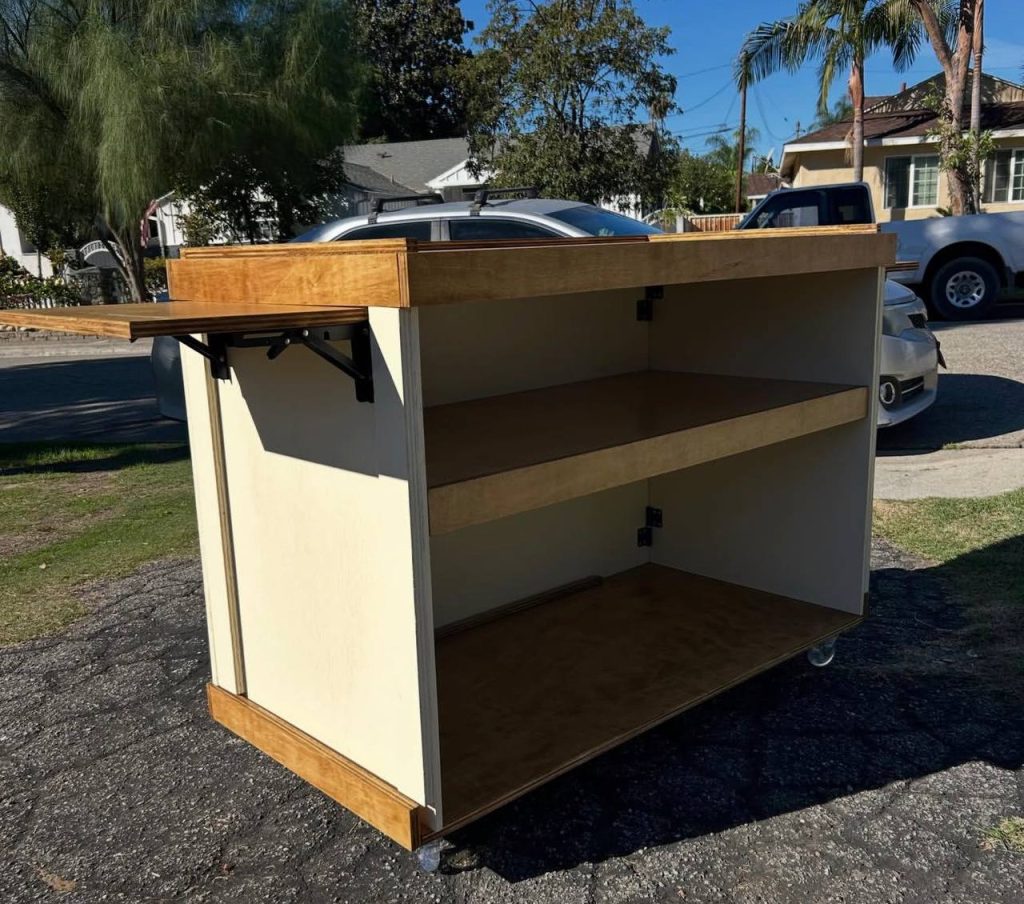
A fixed cart is glued and screwed together once, in the shop, and never comes apart again. The joints are permanent, which means we can use glue in every one of them, and a glued plywood box is remarkably rigid. There is nothing to tighten, nothing to lose and nothing to forget. You roll it off the trailer, drop the casters’ brakes, fold out the shelves and you are open.
The cost is bulk. A fixed 72 inch cart is a 72 inch object every minute of its life, including when it is in your garage and when it is being shipped across the country. Freight for a crated cart is priced on size and weight, and a fixed cart is the largest version of itself. If you live within driving distance of the shop or you already own an enclosed trailer, that is not a problem. If the cart needs to go on a freight truck, it is a real line item.
A fixed cart also has to fit your vehicle as a single piece. Measure the cargo opening of what you drive before falling in love with a long bar.
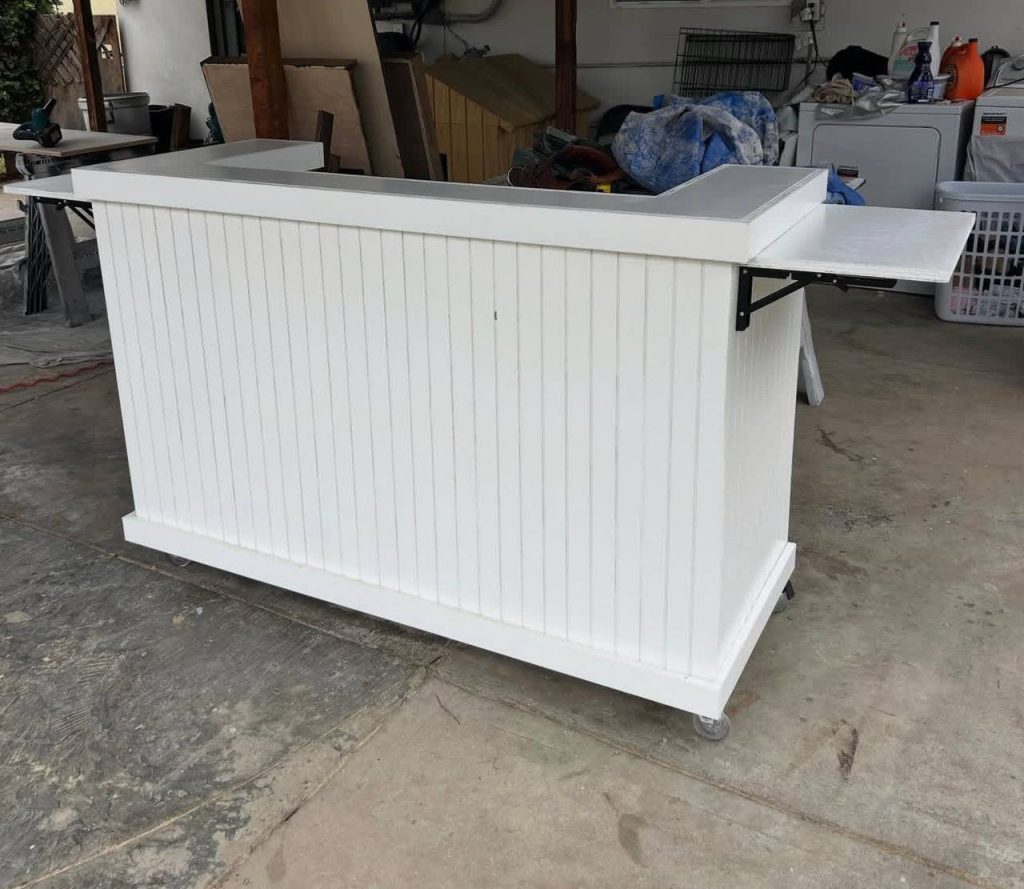
Flat pack kits: the same cart, shipped as panels
A flat pack kit is a fixed cart that has been designed so the main panels bolt together instead of being glued. The sides, back, counter, shelves and base ship as finished parts in a crate that is a fraction of the volume of an assembled cart. You put it together once, in your own garage, and from then on it behaves like a fixed cart. Most people never take it apart again.
What makes a kit work is not the hardware, it is the design. The panels have to locate each other so that the box is square without anyone checking it with a tape. We do that with machined dados, dowel holes and threaded inserts so each screw pulls the joint tight in the right place. A kit held together with corner brackets and screws into end grain is a different thing, and it will loosen.
Things to ask of any flat pack cart, ours or anyone else’s:
- Are the panels pre finished? Finishing a cart after assembly in a garage never goes as well as finishing flat panels in a spray booth.
- Does it use metal threaded inserts or a cross dowel system, rather than wood screws into plywood edges?
- How many fasteners, and how long does assembly take with two people? A reasonable kit goes together in an afternoon.
- Can it be taken apart again without damaging the finish, if you ever need to move house or ship it?
The trade off is a small loss of rigidity compared with glued joints, and an afternoon of your time. For most people the freight saving more than covers both.
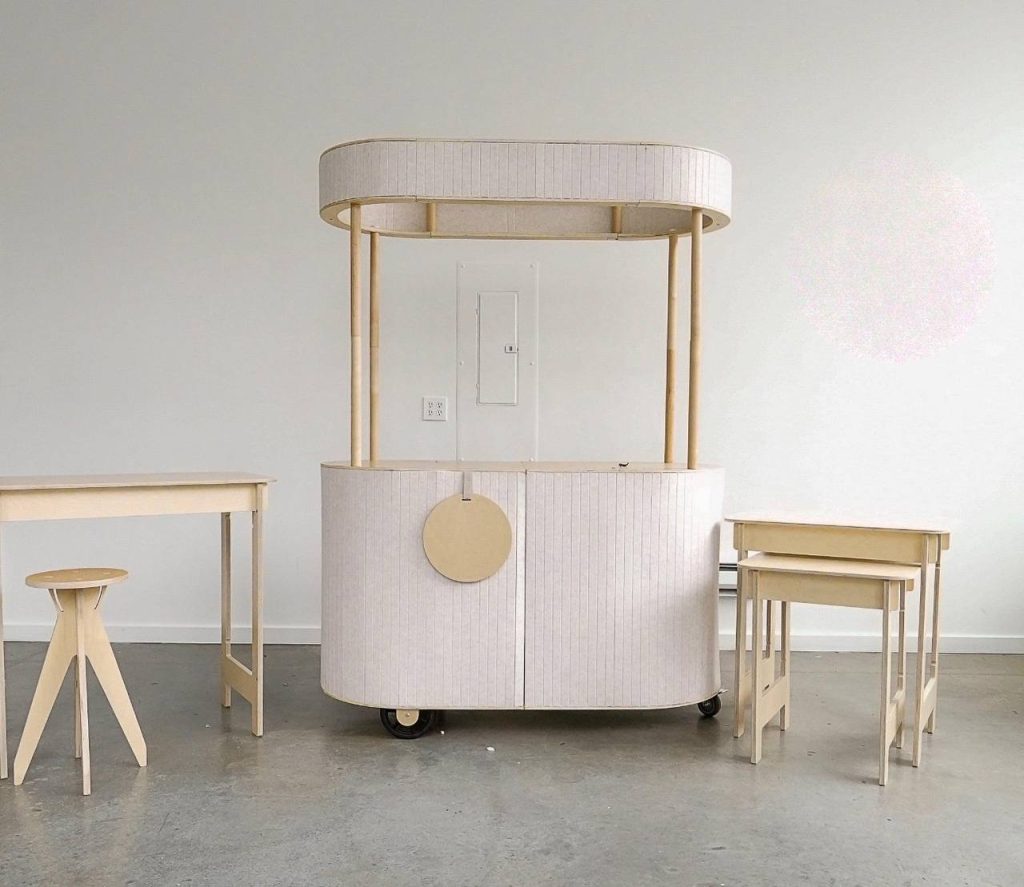
Collapsible carts: built to come apart every time
A collapsible cart is a different animal. It is designed so that after every event it folds flat, nests, or breaks into pieces small enough to fit in a sedan or carry up stairs. That is a genuine advantage for a specific operator: the person without a trailer, the person working a market in a city with no parking, the person who stores the cart in an apartment.
The costs are real and they add up over a season.
- Weight. A collapsible cart needs hinges, latches, folding legs and reinforcement at every fold, and it is often heavier than a fixed cart of the same size.
- Time. Setup and teardown take longer, every time, forever. Fifteen minutes each way across a hundred events is fifty hours.
- Wear. Every hinge and latch is a part that works loose, and every panel edge that is handled twice a day gets dinged.
- Water. A cart that comes apart is harder to plumb. Sinks and tanks either come off as a unit or the lines have to be disconnected, and every disconnect is a chance for a drip.
- Rigidity. A folded joint is never as stiff as a glued one, and a wobbly counter under an espresso machine is unpleasant to work on.
None of that means collapsible is wrong. It means it is a tool for a particular job. If your constraint is genuinely that the cart has to fit in a hatchback or go up a flight of stairs, a collapsible cart is the only one of the three that solves the problem, and it is worth the extra setup time. If you have a trailer or a van, it is usually the wrong choice.
What about canopies, shelves and accessories?
Even on a fixed cart, some parts come apart. Canopy posts, fabric tops, menu boards and side tables are nearly always removable, because a cart with a canopy on it does not go through a door. Fold down end shelves are a middle path: permanently attached, but out of the way when rolling. The question is not whether anything is removable, it is how many pieces you have to keep track of. Our rule of thumb is that anything that comes off should either fit inside the cart for transport or stack flat against it.
How to choose
Ask yourself four questions, in this order.
- How will the cart travel on event days? Trailer or van: fixed or flat pack. Car or hatchback: collapsible, and accept the trade offs.
- How will it arrive from the builder? Local pickup: fixed. Freight across the country: flat pack saves a great deal.
- How often will it set up and tear down? Daily: avoid anything that needs assembly. A few times a month: either is fine.
- Does it need plumbing? Sinks and tanks push you toward fixed or flat pack, because they want to stay connected.
If you answered trailer, freight, a few times a month and yes to plumbing, a flat pack kit is almost certainly right. If you answered trailer, local, daily and yes, buy the fixed cart and never think about it again. If you answered hatchback, your choice is made for you, and the thing to do is to pick a collapsible design with as few parts and as few hinges as possible.
A note on second hand carts
People sometimes buy a used collapsible cart because it is cheap and discover why it was cheap. Before you buy any used cart, set it up and tear it down yourself, twice, and look at the condition of every hinge, latch and panel edge. A fixed cart that has been used hard will show its wear in the finish, which is easy to fix. A collapsible cart that has been used hard will show it in the joints, which is not.