Water is the heaviest, messiest and most regulated thing on a cart, and getting it right matters more than almost any woodworking decision. A good water system is one you never think about during a shift: the pump cycles, the hot water is there, the waste tank does not overflow and nothing drips onto the plywood. This article covers how we think about tanks, pumps and hot water on the carts we build, with the usual caution that capacities and temperatures are set by your health department and vary by county and state.
Three kinds of water on a cart
It helps to separate the water on a cart into three systems that may or may not be connected.
- Handwash water: fresh tank, pump, heater, basin, waste tank. Small volume, required nearly everywhere.
- Equipment water: the supply to an espresso machine, brewer or water boiler. Usually filtered. Either from its own tank with a pump, or shared with the handwash supply, or poured in by hand into a machine with a built in reservoir.
- Rinse and wash water: the supply and waste for a three compartment sink or a pitcher rinser, if the cart carries them. Larger volume, and the thing that pushes a cart from small tanks to big ones.
A cart that only carries a pour over brewer with a reservoir and a handwash sink can get by with a pair of small tanks. A cart with a plumbed two group machine, a pitcher rinser and a three compartment sink is carrying a small kitchen’s worth of water, and it is designed differently from the floor up.
Sizing the tanks
Two rules of thumb show up in most mobile food codes, and we design to them unless a county tells us something different.
First, the waste tank should be larger than the fresh tank. A figure of about 15 percent larger is commonly cited. The logic is simple: everything that leaves the fresh tank ends up in the waste tank along with whatever else goes down the drain, so the waste must have room to spare. Second, there is usually a minimum fresh capacity for handwashing alone, with five gallons being a number that appears in a lot of codes. Operations that also wash utensils on board are typically required to carry much more.
Beyond the code minimum, size the fresh tank to your longest shift. A busy coffee cart can go through a surprising amount of water between the machine, rinsing pitchers and washing hands, and running out mid shift means closing or carrying jugs across a field. Most operators we talk with land somewhere between a pair of five gallon tanks and a pair of fifteen gallon tanks, depending on their menu and whether they can refill on site. Remember the weight: water is a little over eight pounds a gallon, so fifteen gallons is around 125 pounds in a single tank before the tank itself.
Tank types and where they go
The tanks on most carts are either rigid food grade polyethylene containers with a threaded cap and a bulkhead fitting, or the stackable jug style with a spigot. Rigid tanks with proper fittings are easier to plumb and less likely to leak, and they can be strapped down. Jugs are easier to carry to a sink to fill, which matters if your commissary does not have a hose.
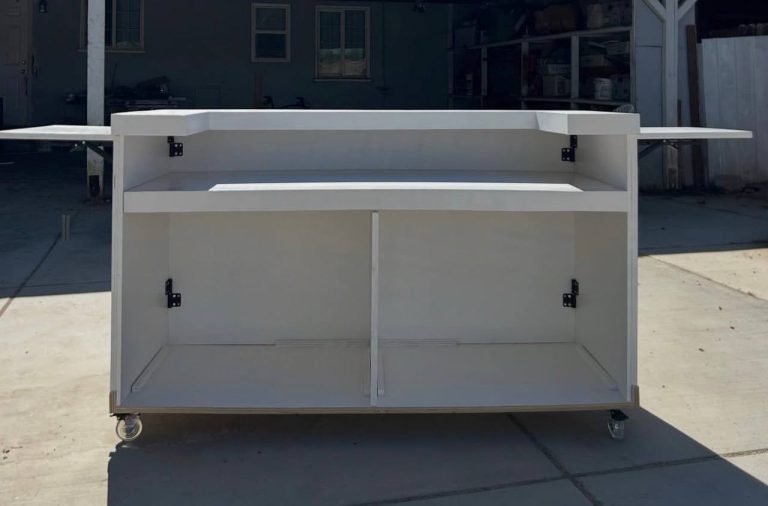
Wherever possible we put the tanks on the floor of the cabinet, over or near the casters that carry the load, and we make sure they come out through the open back without tools. A tank that has to be lifted over a shelf or tilted past a heater will be filled less often than it should be. We also leave room around each tank for the fittings and a hand, because tightening a bulkhead fitting in a space you cannot see into is miserable.
Label the tanks fresh and waste, in letters big enough that a tired person at six in the morning cannot mix them up. Inspectors tend to look for the labels too.
Pumps
The standard pump on a cart is a 12 volt diaphragm pump with a built in pressure switch, the kind sold for boats and recreational vehicles. It turns on when a tap opens and the pressure drops, and turns off when the tap closes. They are quiet enough, cheap, and parts are everywhere. Things that matter when choosing and installing one:
- Match the flow rate to the job. A handwash sink needs very little. A three compartment sink or a pitcher rinser wants more.
- Fit a strainer on the inlet. Debris from a tank is the most common reason a pump chatters or sticks.
- Mount it on a rubber pad or isolation feet. A pump screwed straight to a plywood panel turns the whole cart into a drum.
- Run it from a dedicated 12 volt supply, either a small power supply off shore power or a sealed battery with a charger. A pump that shares a circuit with a heater will stall when the heater kicks in.
- Put the switch where you can reach it from the working side of the cart, so you can shut the pump off the moment you see a drip.
Some machines, especially espresso machines with a built in rotary pump and a reservoir, do not need an external pump at all. Check the manual: feeding a machine that expects to draw from a reservoir with a pressurized line can damage it, and feeding one that expects line pressure from a gravity tank will not work.
Hot water: the hard part
Health departments commonly require warm water at the handwash sink, with a temperature around 100 degrees Fahrenheit being widely cited, and hotter water for washing dishes if that happens on the cart. On a cart, heating water comes down to a few options and all of them have a catch.
A small storage water heater, holding one to a few gallons and running on 120 volts, is the most common solution. It keeps a small amount of water hot, recovers slowly, and typically draws in the neighborhood of a kitchen appliance while heating. The catch is that it is one more heavy load on an electrical budget already stretched by an espresso machine, and it needs to be reachable to reset and to drain for winter.
An instant electric heater, sometimes called tankless, heats water as it flows. Small 120 volt units exist and are tempting because they are compact. Their catch is that heating water quickly takes a lot of power, and the small ones that fit a cart’s electrical budget raise the temperature by only a modest amount, which may not be enough on a cold morning with cold tanks.
Gas heating, by propane, is used on some larger units and food trucks. It solves the electrical problem and creates a fire code problem, with cylinder mounting, ventilation and often a separate inspection. For a cart that works indoors at weddings it is rarely the right answer.
Finally, some operators are allowed to heat water in an electric kettle or urn and mix it at the sink, or to carry hot water from a commissary in an insulated container. Whether that is acceptable is a county question. Ask.
Whichever you choose, place the heater close to the sink to keep the hot line short, insulate the line if it is more than a couple of feet, and make sure the heater’s drain valve is reachable. Water left in a heater over a hard freeze is the end of that heater.
Drains and waste
Every drain on the cart needs a continuous downhill run to the waste tank, with no sag where water sits and sours. We use smooth bore tubing rather than corrugated hose for exactly that reason, and we keep the runs visible. A simple trap or loop on each line keeps smells from the waste tank out of the sink. The waste tank gets a vent so it does not glug and back up, and a large cap or a dump valve so emptying it is a two minute job rather than a wrestling match.
Where the waste goes is a legal question with a short answer: a sanitary drain, at a commissary or another approved location. Not a storm drain, not the grass behind the venue.
Winter
If you store a cart anywhere that freezes, drain the tanks, the heater, the pump and the lines, and leave the taps open. A pump housing cracked by ice is a common spring repair, and a heater split by ice is a replacement.
The checklist we work to
- Confirm fresh and waste capacity and hot water requirements with your county.
- Size fresh to your longest shift, waste to the rule, and check the loaded weight.
- Rigid tanks with bulkhead fittings, strapped, labeled, removable without tools.
- A 12 volt diaphragm pump with an inlet strainer, isolation mounts and its own power supply.
- A small storage heater near the sink, reachable, with a drain valve you can get to.
- Smooth drain lines with continuous fall, a trap on each, a vent on the waste tank.
- Everything visible from the open back of the cart.
None of it is complicated on its own. The art is in fitting all of it under a counter, next to the casters, in a way that can still be reached for cleaning, which is why we draw the water system before we draw anything else below the counter.