Sinks are where a cart stops being furniture and starts being a food service unit. They also account for more of the back and forth in a build than anything else, because the requirements come from the health department, the plumbing has to fit inside a box the size of a dresser, and the whole thing has to survive being rolled across a parking lot. Here is what we have learned about putting handwash and three compartment sinks on carts, and what to settle before the first cutout is made. Rules vary by county and state, so treat every requirement here as something to confirm with your own health department.
The handwash sink: small, separate and always working
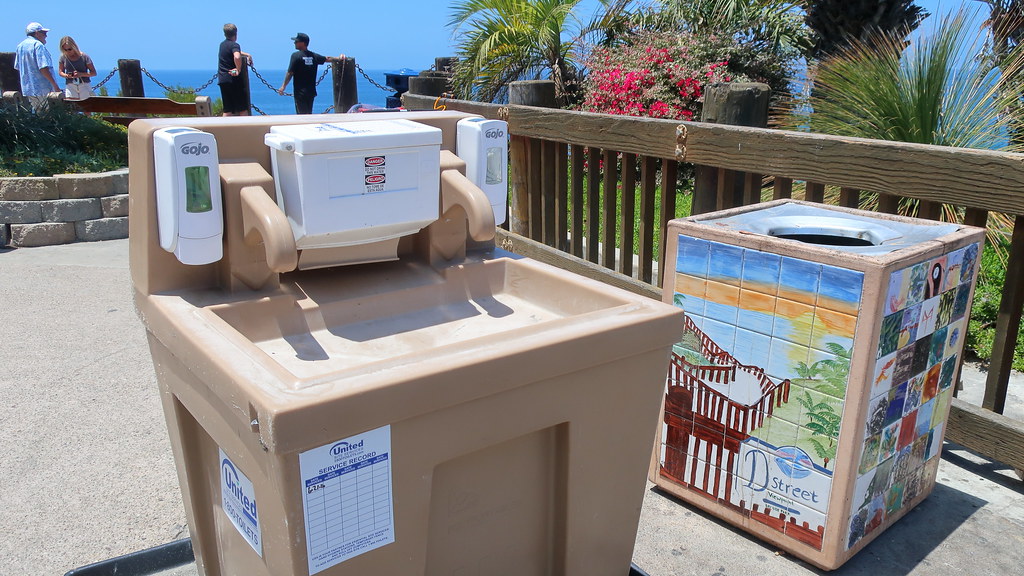
Nearly every health department asks for a dedicated handwash sink on any mobile unit that handles open food or drink. Dedicated means it is used for hands only, not for rinsing pitchers or dumping leftover milk. Common requirements include a basin of a minimum size, a mixing faucet or separate hot and cold taps, water that reaches a warm temperature at the tap (a figure around 100 degrees Fahrenheit is commonly cited), soap and paper towels in dispensers, and a catch tank for the waste water.
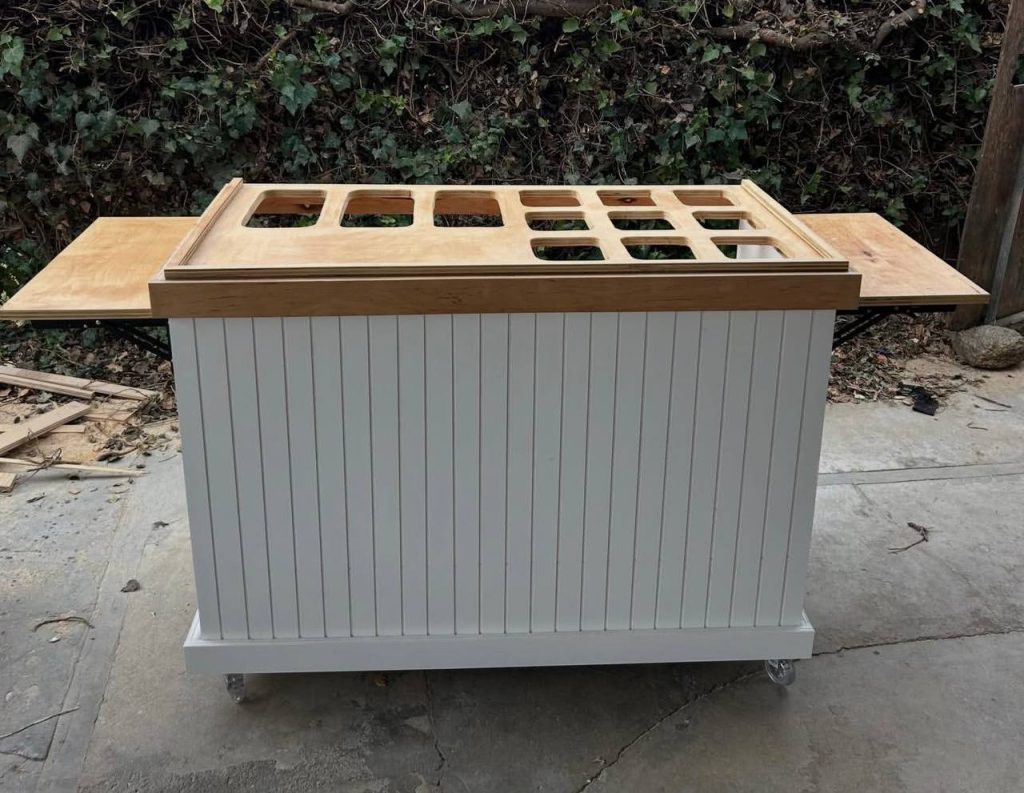
What that looks like on a cart: a small stainless drop in basin, typically on the order of 10 by 14 inches, set into the counter near the end of the working area. Below it, a fresh water tank, a small pump, a point of use water heater and a waste tank. The basin is small on purpose. A handwash sink that is big enough to be tempting for other jobs will get used for other jobs, and an inspector who sees a pitcher in it will say so.
The three compartment sink: whether, and where
The three compartment sink is for washing, rinsing and sanitizing utensils and equipment, in that order, one compartment each. Many jurisdictions require one on the mobile unit itself for any operation that uses reusable utensils, pitchers or portafilters. Others allow the washing to happen at a commissary and ask only for a handwash sink on the cart. Some split the difference and accept a three compartment sink at the commissary provided the cart carries enough clean spares to get through a shift. The only way to know is to ask, and to ask specifically about your menu, because the answer often depends on whether you handle anything beyond prepackaged items.
If you do need one on the cart, understand what it does to the design. A three compartment sink is three basins plus two drainboards, and even the compact versions made for mobile units take a large share of a cart’s counter. Each basin needs to be large enough to submerge your largest utensil, which for a coffee cart is usually a steaming pitcher or a portafilter. Compact units with basins around 10 by 14 inches are common on carts; larger operations need more.
It also multiplies the water. Three basins filled for a proper wash cycle use a good number of gallons, which means larger fresh and waste tanks, which means more weight, which brings us back to casters and to how the cart is moved.
Drop in versus built in
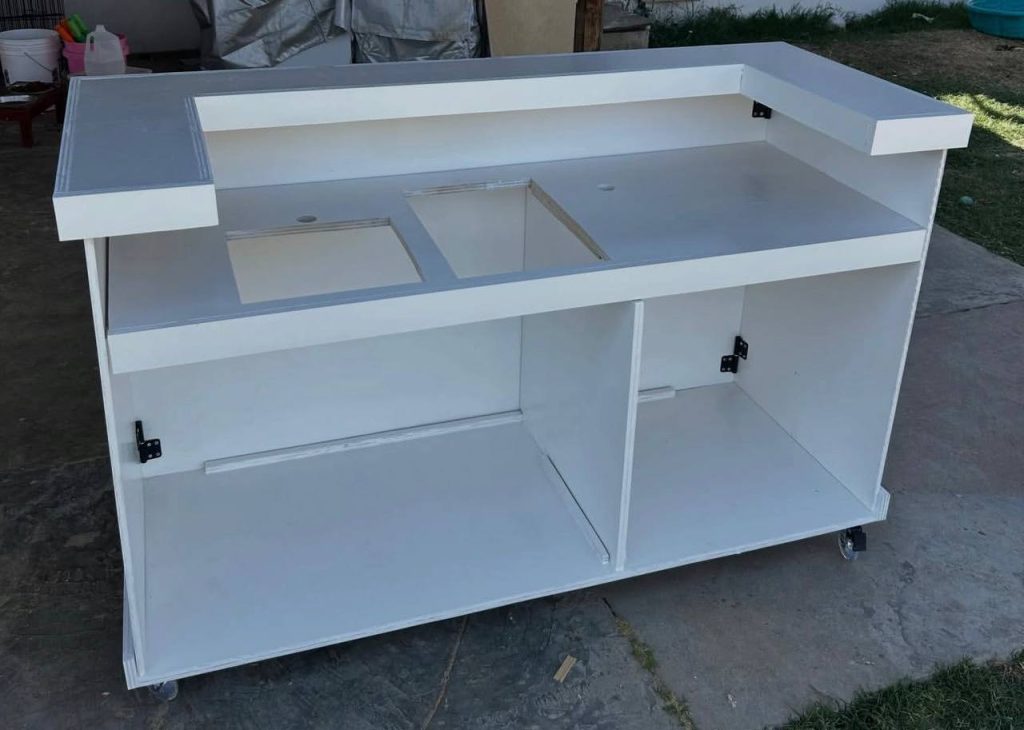
We prefer stainless drop in basins set into cutouts in the counter, with a sealed rim, over anything built into the plywood itself. Reasons:
- A stainless basin is a food safe surface that inspectors recognize on sight.
- It can be removed and replaced if it is damaged, without rebuilding the counter.
- The cutout can be sealed and the rim caulked so water does not reach the plywood edge, which is where plywood fails.
- Standard basins come with standard drain fittings, which keeps the plumbing simple.
The counter around a sink takes more abuse than any other part of the cart. We finish the cutout edges with the same sealing attention as the top surface, and we favor a counter finish around the sink that tolerates standing water. If a cart will carry a three compartment sink, a solid surface or stainless insert for that section of the counter is worth considering, with the maple reserved for the parts guests see and touch.
Tanks, heights and gravity
Every sink needs a fresh tank above or beside it with a pump, and a waste tank below it that fills by gravity. The waste tank has to be lower than the lowest drain, and the drain lines need a continuous fall to it with no low spots where water sits. Inside a cart that is under 36 inches tall, with casters eating the bottom few inches, that is tighter than it sounds. It is one of the main reasons we design plumbing on paper before the carcass is built, rather than fitting it afterward.
The commonly cited rule is that the waste tank should be larger than the fresh tank, often by around 15 percent, so that it cannot overflow before the fresh runs out. Many jurisdictions also set a minimum fresh capacity for handwashing alone, with five gallons being a figure that comes up a lot. Confirm both numbers locally; they are the kind of thing an inspector checks with a tape measure and a label.
Faucets, pumps and heat
For a handwash sink, a small 12 volt diaphragm pump with a pressure switch is the usual arrangement. It runs from a power supply when you have shore power or a small battery when you do not. Foot pumps and hand pumps are accepted in some jurisdictions and not others. Where hot water is required, a small point of use electric heater, often holding a gallon or two, sits under the counter and keeps the water warm. Instant electric heaters exist but draw a lot of power and are hard to feed from a cart’s electrical budget, as covered in our article on tanks, pumps and hot water.
For a three compartment sink the pump needs to deliver more water faster, and the heater needs more capacity, because you are filling basins rather than rinsing hands. This is the point where some operators decide the commissary option is the better one.
Keeping it cleanable
Whatever sinks you carry, the inspector wants to see that the area around and under them can be cleaned. Practically:
- Open access to the cabinet below the sinks, with no fixed shelf blocking the tanks.
- Smooth, sealed surfaces inside the cabinet. We finish the inside of the sink bay as carefully as the outside.
- Drain lines you can see along their whole length, with no hidden runs through closed cavities.
- Tanks that come out without tools, for filling and for cleaning.
- A drip tray or lip under the pump and heater, because fittings weep eventually.
Mounting the small stuff
Soap and paper towel dispensers should be mounted, not loose, and placed where a wet hand can reach them without dripping across the counter. On a cart, that often means mounting them on the inside of a raised front ledge or on a short panel beside the sink. A splash guard between the handwash sink and any open food area is commonly required and easy to add as a short upstand of the same material as the counter. Sanitizer test strips live in a small container near the three compartment sink or wherever you mix sanitizer.
A planning sequence that works
- Ask your health department which sinks are required on the unit, their minimum dimensions, water temperature and tank capacities. Get it in writing.
- Decide whether a three compartment sink is on the cart or at a commissary.
- Choose the basins and faucets and note their exact cutout dimensions and depths.
- Size the fresh and waste tanks to the rule your county uses, then check they fit under the counter with the heater and pump and still clear the casters.
- Lay out the drain lines on the drawing with a continuous fall.
- Only then fix the counter layout, because the sinks have just told you where everything else can go.
Sinks are not glamorous and they are the part of the cart that inspectors spend the most time on. Get them right on paper, build them so they can be reached and cleaned, and they will quietly do their job for years.